A blog about knitting, science, video games, and anything else I think is cool, with a few free patterns thrown in here and there. For scientists, knitters, nerds, crocheters, geeks. But not for dorks.
Ah, nothing like resurrecting a long-dead medium. I guess I just got bored with having a blog.
In the past two years a lot of things have happened. My last post was just after I started my work as a programmer. It was before my epilepsy was diagnosed, which has been a whole other pile of shit to deal with.
But I've still been knitting, playing video games, doing the things I like. And I have a huge backlog of things I could have been writing about and sharing but didn't. A lot of items that I could have written up as patterns but was too lazy to do it.
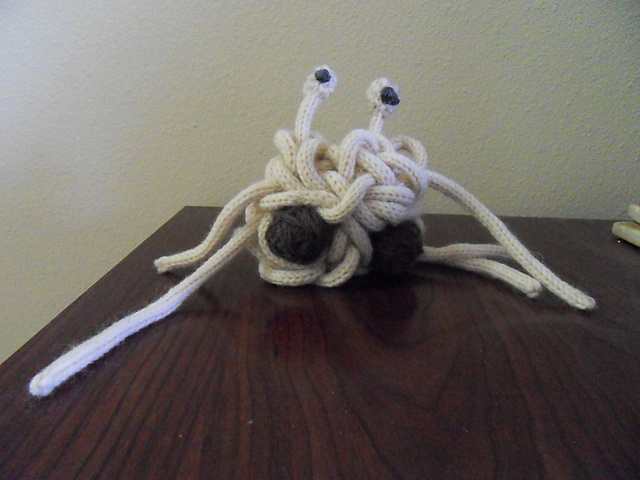
Here's one example: the evolutionist's baby toy! Although it's really easy, it pretty much doesn't require a pattern at all, so this is more of a tutorial.
I present to you the Flying Spaghetti Monster!
(artist's impression)
Sport or fingering weight yarn in an off-white color
Yarn in some kind of brown wool
A piece of something semi-stiff - wire, plastic foam sheets, whatever, to hold up the eye stalks
Plastic eyes, if his noodly appendage driveth you so
A sharp needle with a big enough eye for yarn
Washing machine or a needle felter
Patience or one of these cool bastards
The Embellish-knit is basically a tiny knitting machine with four latch hooks. You feed in the yarn correctly and turn the crank and out comes a truly ridiculous amount of 4-stitch i-cord. I bought one as a whim, years ago, and this is pretty much the only interesting thing I've done with it since I had it.
So get it started with the off-white yarn. I made it work with really light worsted - fisherman's wool - but anything heavier than that will jam the machine. Make sure to weight the yarn coming out the bottom appropriately - it comes with a tiny little clip-on weight thing that is not near heavy enough for my tastes. If it's not weighted enough the needles won't grab it and it'll get wonky and fall out of the machine. . Find something heavier you can tie it to - it doesn't have to be huge. I think I used a roll of duct tape. Now spin that crank until you have a lot of i-cord, a pile of i-cord - 15 feet of i-cord, at least, and more if you want him to be really noodley. It doesn't take all that long, but if you feel the need for speed or you are channeling Tim Allen and feel that your work just doesn't have enough testosterone yet, I'd recommend this high-tech method shared by 1klik6.
Or, if you are Catholic and have been looking for a penance, you can knit it all by hand!
You need at least three longish pieces so you can make them separately if you like; I didn't want to bother so I just did the whole thing in one go. It spins as it comes out the bottom of the machine so you have to let it hang freely. As I made more cord I just bundled and tied it up to keep it off the floor.
Now it's time to make yourself some balls - even if you've got a pair, you need two more for this. You could knit or crochet a ball, but I just rolled up the brown yarn into a ball and needle felted it around. You could also throw a couple of rolled-up balls into the washing machine, but make sure they are bigger than you want and maybe wrap em in a piece of panty hose or something to make sure they don't come apart.
Start assembling the main body. If you have one long i-cord, cut it into pieces and thread the loose end of the yarn through the four exposed stitches on each side of the cut. I had one really long piece to serve as the two main noodles, and two other pieces to serve as body and shorter noodles. This part is really easy and sort of free-form. I started with one piece looped into a figure eight, where the holes in the 8 were just big enough to cradle the meatballs, then I tacked the balls onto the noodles with a few strands of the white yarn. You need that sharp needle to poke into the meatballs.
Shape the piece of something pointy into the eyestalk holders. Bend a piece of wire into a U, or cut a piece of stiff material into that shape. It has to be narrow enough to fit inside the i-cord. Slip a short piece of i-cord over it and fix it in place between the meatballs. At this point you could attach googley eyes or beads or something, I just knitted small balls atop the eyestalks and embroidered pupils onto them.
Now here comes the artistic part where this becomes really you - loop the noodles around however the fuck you want. It's that simple! Once you've got them good, you can tack some of them in place too, so he won't just unravel. Leave at least two longer ones and let the ends of the shorter ones poke out here and there to get that really realistic noodly look.
And there you have it. Your very own tribute to the gods of Evolution.
Then I realized there was no pattern listed. What? I know I hadn't come up with this idea on my own. Where was the pattern? I searched Ravelry frantically, because this sort of thing bugs me. No luck. Kept searching. Still nothing. WTF, mate?
So I googled it, and then I found the source; a post here, about halfway down the page. McLovin (formerly Ax174), I must thank you, because this is such a cool little project. I made several of them, and they travel with me on my purse, knitting bags, etc. I've even given a few away.
But I have become so indoctrinated into the idea that everything, everything should be on Ravelry, that I can't just let it lie. While her post was useful (after all, I made mine by looking at a picture of hers), some people might want a more verbose pattern, with yarn measurements and more explicit instructions.
So here is that more verbose pattern. I actually don't think it needs pictures to be understood, so I decided not to clutter up this post with them. However, here is a post full of those pictures if you want to have a look.
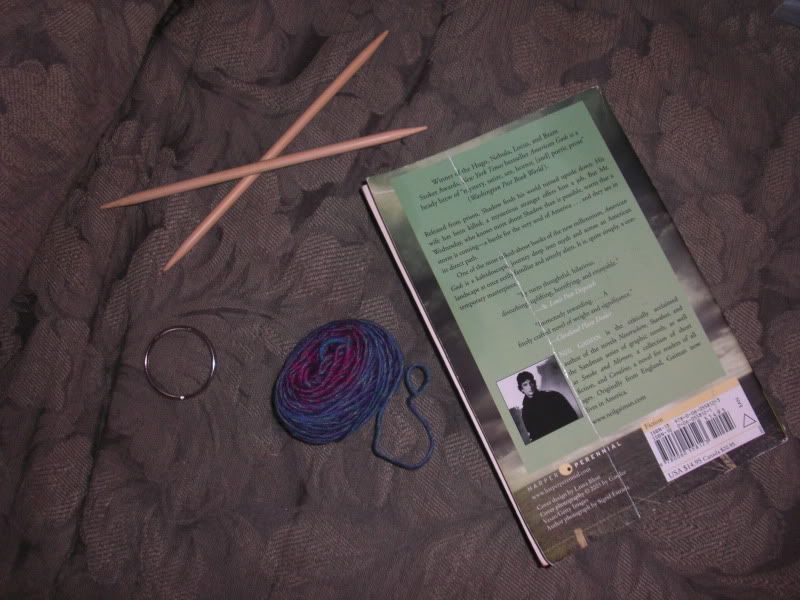
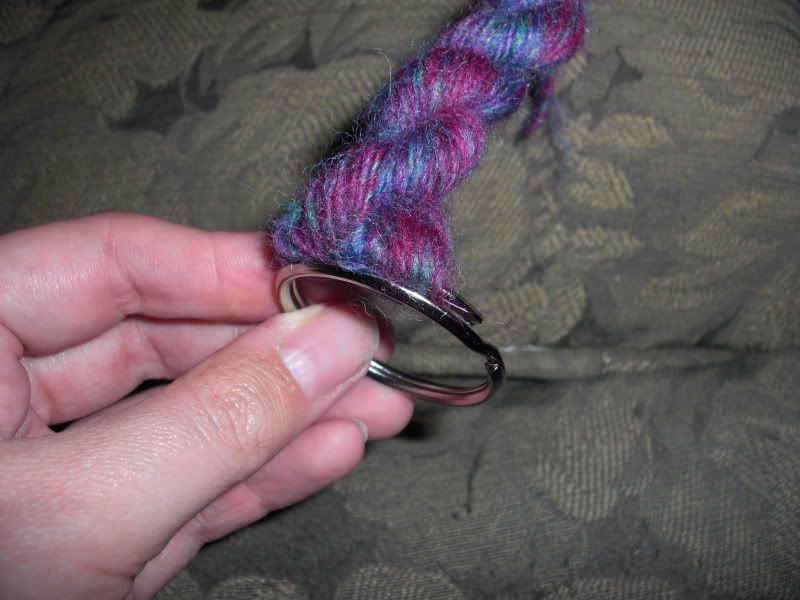
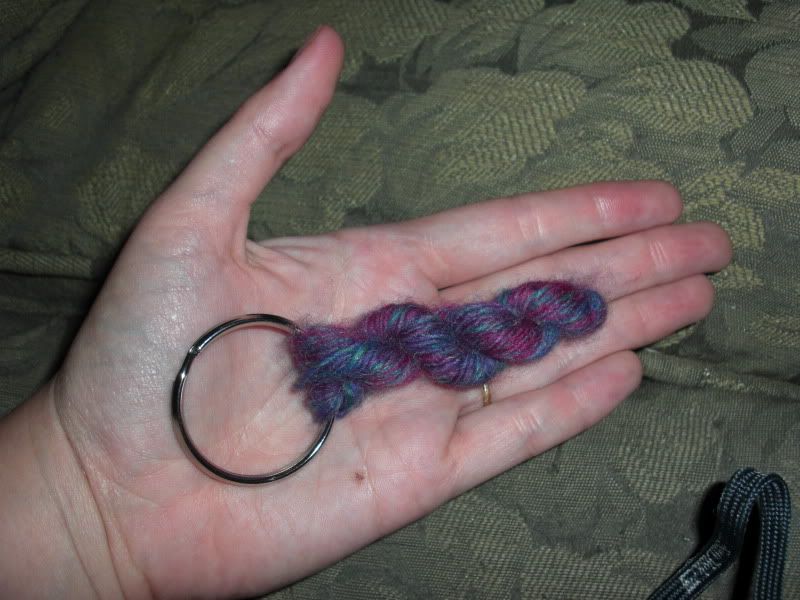
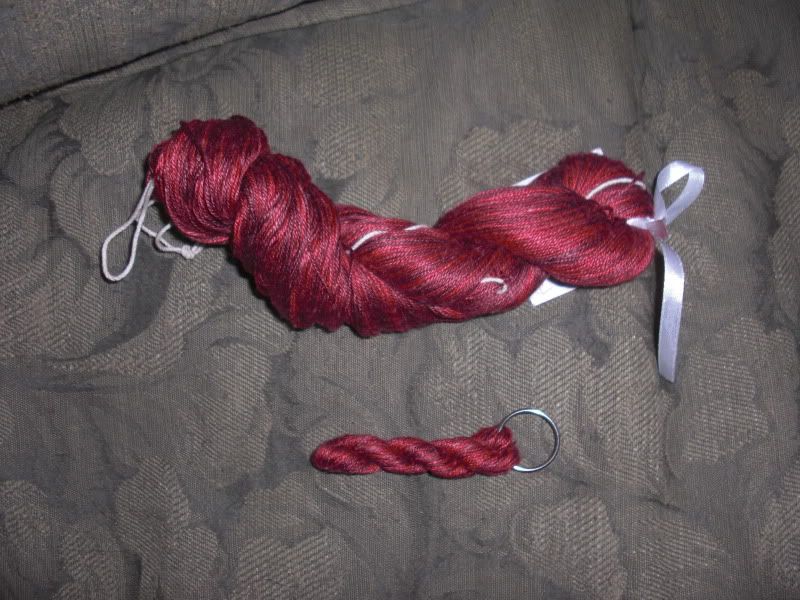
Badge Of Honor Mini-Skein Charm Materials: 4-10 yards of fingering weight yarn, or 8-20 yards of laceweight. You can try this with sport or DK, but I think it might be a little too bulky to give the right effect. 10 yards makes quite a thick skein; the sample above used around 6. Using fingering weight will make a charm that looks like a miniature worsted or bulky weight skein; using laceweight would make a miniature sock-weight skein.
A pair of needles: exact size is unimportant, but I'd recommmend somewhere from US4-US9, not too huge and not too small. These are only needed to put the proper twist into the skein charm. DPNs or straights are equally good.
A keyring
A piece of cardboard, or a book or magazine
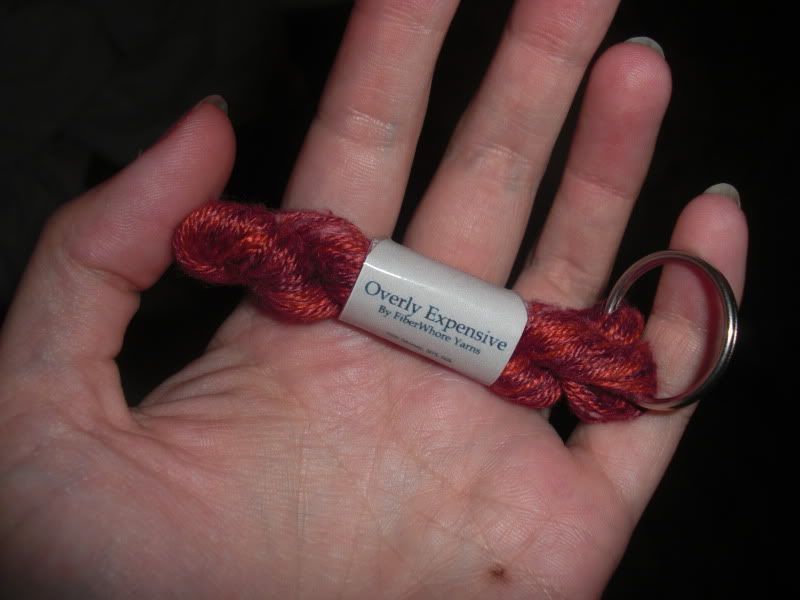
Printer, paper, and clear tape, if you want to make a label.
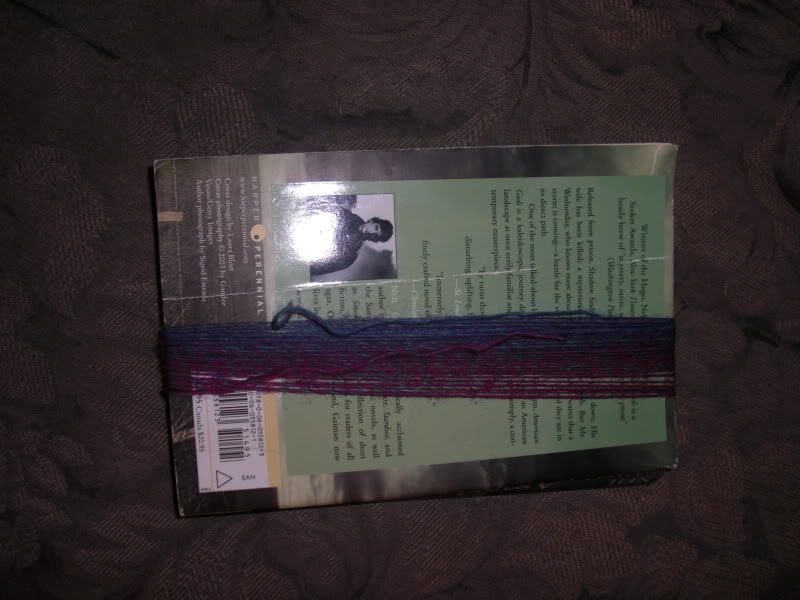
Directions: 1. Cut your cardboard into a rectangle that is 10 inches long and a few inches wide, or find a book around the same size. If you want a longer, thinner skein, make your cardboard longer than 10 inches or find something else long enough - McLovin mentioned that she wraps hers around a magazine. Wind your yarn around it in the long direction until you run out of yarn. Tie the two ends together very securely, and trim the ends so they are short. If you want to be super sure it won't unwind, then put a drop of superglue on the knot and wait for it to try before continuing.
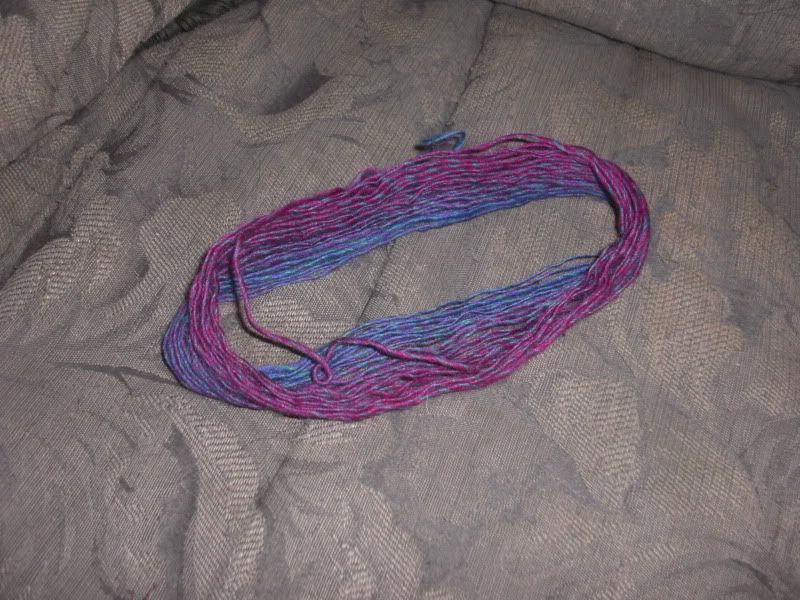
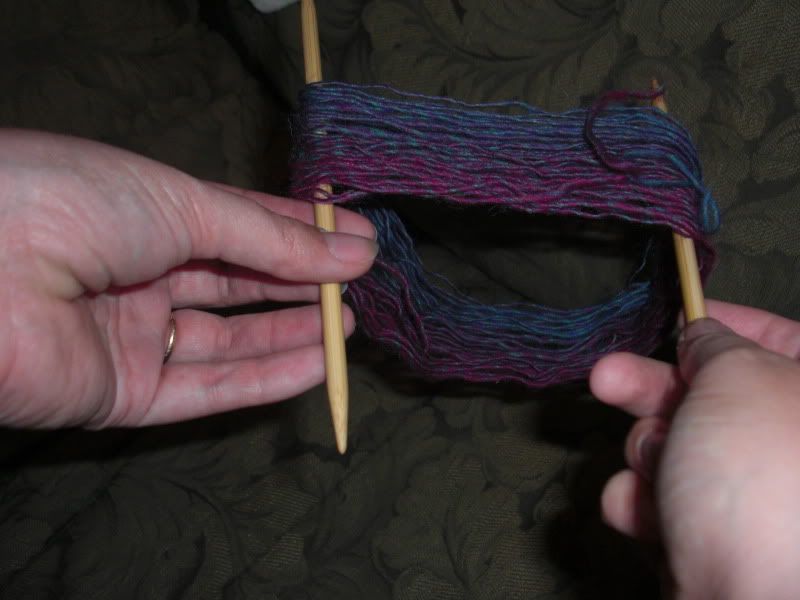
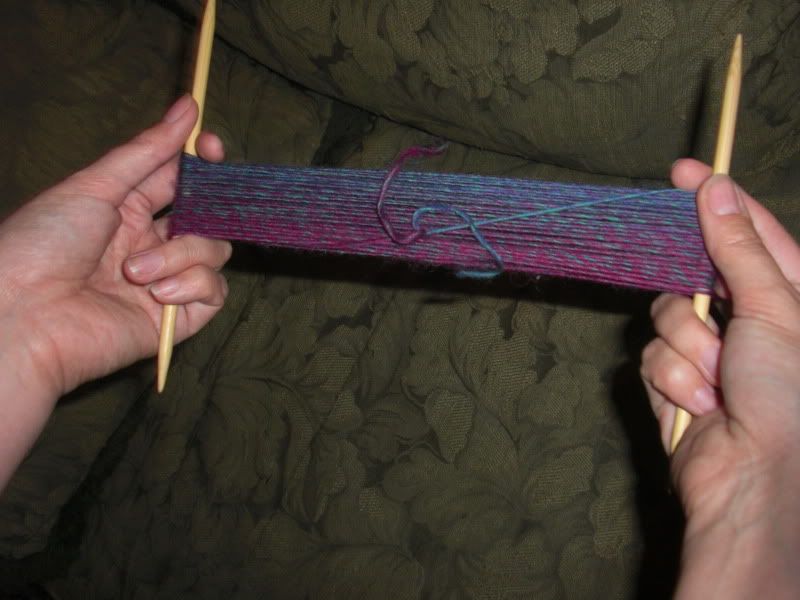
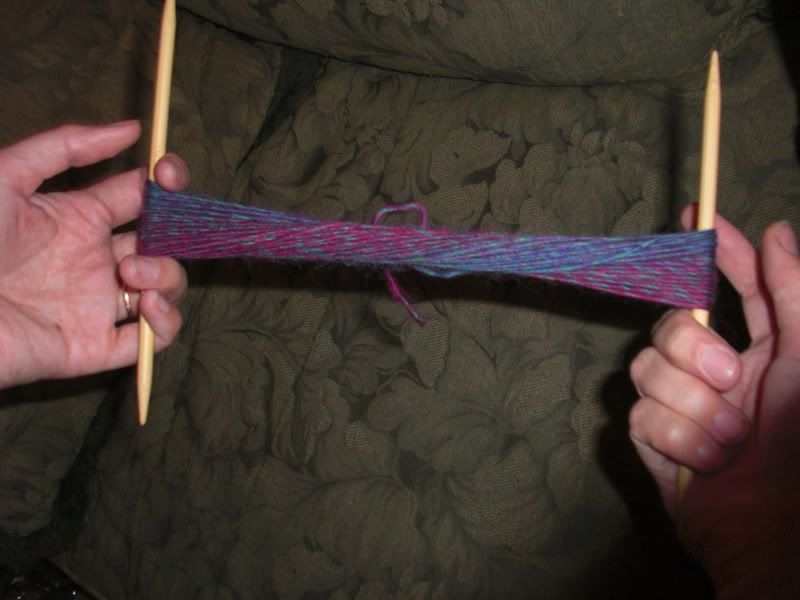
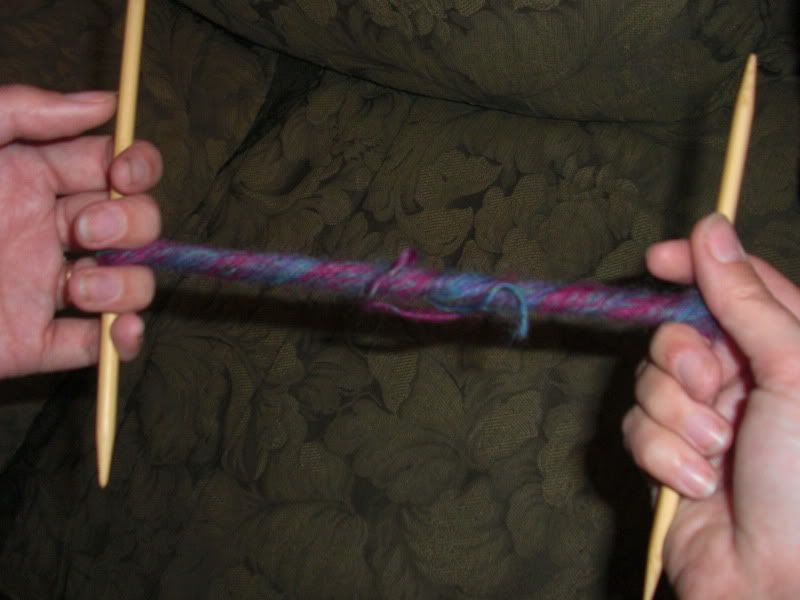
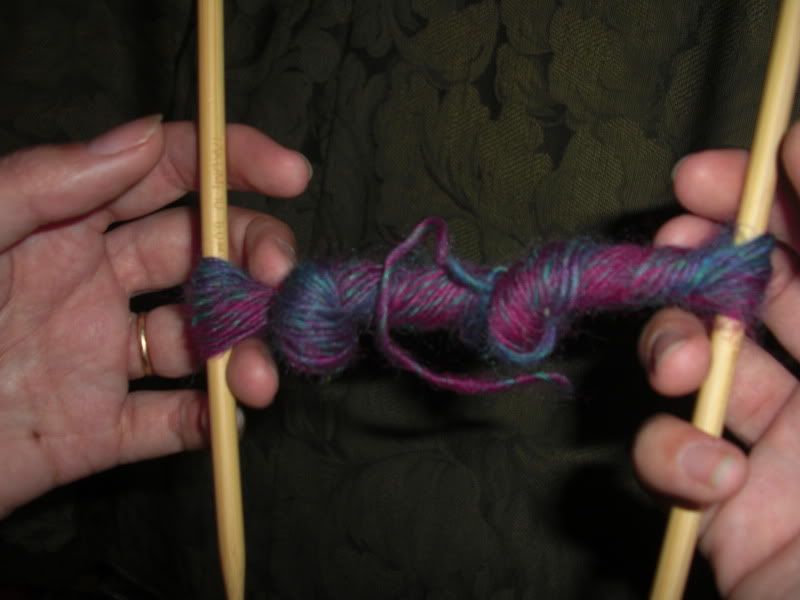
2. Slip the yarn off the cardboard (don't let it unwind!) and put your two needles into the big loop. Hold the needles as far apart as they will go, with the looped yarn stretched between them. Now, use those needles as handles to twist these loops of yarn up pretty good. You'll know you have twisted it enough when the twist starts trying to loop up on itself a little (if this sounds confusing, try it and you will see what I mean.)
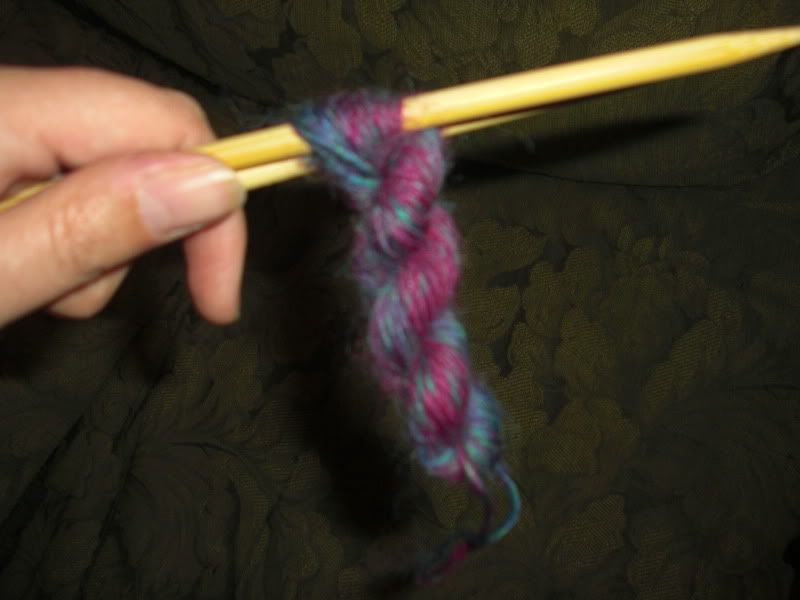
3. Once it's twisted enough, fold it in half, bringing the two needles together. It should twist into a skein shape on its own at this point. If the skein seems too loose, unfold it and twist the yarn some more before refolding.
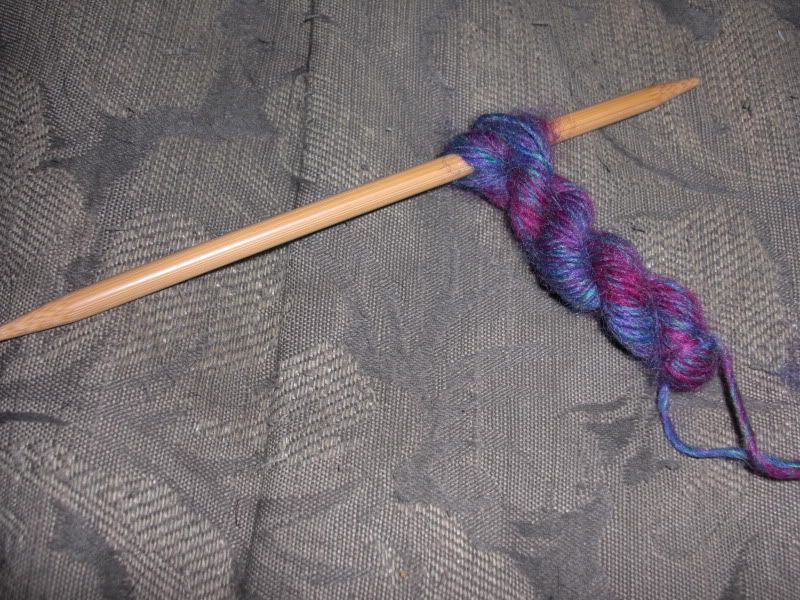
4. When you're happy with the appearance of your skein, you can take out one of the needles (carefully, so it doesn't unwind) and transfer those loops onto the other needle; this will hold the skein in position.
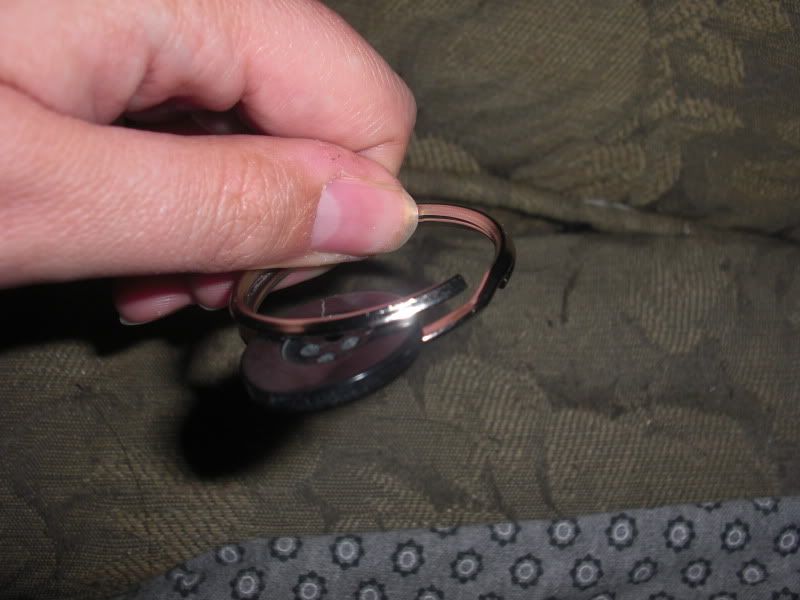
5. Now it's time to put it on the keyring. This part can be a bit tricky, especially if you have a really stiff keyring. What you need to do is hold the keyring open and slip all the loops of yarn on your needle onto the keyring, the same way you'd put a key on there. I find that sometimes, forcing the ring open, then wedging something like a button in there helps hold it open while you load in the yarn.
Slide the loops all the way around (again, like you do to put a key on) until the skein is completely on the keyring, and you're finished!
If you want to make a label, below are some label templates I made for mine. I printed mine out and covered it with clear packing tape to make it a little more stable, then put it around the skein and taped it closed. Be aware, the label won't hold up to abuse like the skein does - I lost the label off mine some time ago, but I have found that I actually like it better this way, you see more of the yarn.
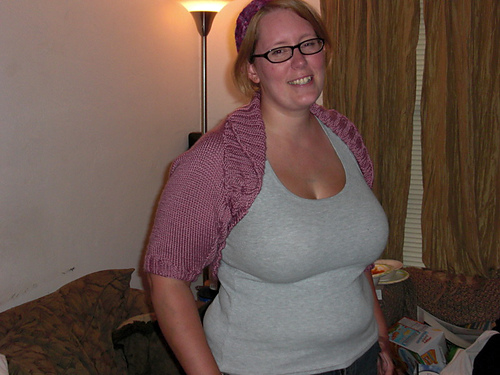
Anyway, a while ago I made a nice shrug on my Bond USM, and like an idiot I gave it a pattern page on Ravelry . . . without actually writing up a pattern. My apologies for that, to the one person who seemed to be interested! Without further delay, here is the pattern. Right now it only comes in plus sizes - in other words, me-sized - but I'll at least work out a recipe to resize it.
Quick and Cute Shrug
This is knit mostly like the bond shrug, but it incorporates shaping so that it is a better fit! I noticed a lot of pictures of the finished object on Ravelry looked a little baggy around the armpits, so this version starts out narrow at the elbow, widens to the widest part of the arm, and then shrinks again so that the back is a good fit (and does the reverse for the other arm). It is knit sideways, so it starts at the end of one sleeve, knits along the arm and across the back, then down the other sleeve.
The Simply Soft makes a silky and not too elastic shrug. The one I'm wearing in the picture has perhaps one inch of negative ease, so it clings a little, but the ribbing remains stretched out and flexible. If you want something more elastic and clingy, you might try a wool yarn of similar gauge. Just check your tension first.
Now resized for S, M, L, or XL! I wrote it for me, which means size XL, so the measurements for S,M,L can be found in parentheses before the measurement for XL. Arm just above the elbow, (7", 8", 10") 12" around. Arm at largest point before armpit: (11", 12", 14") 16" around. Cross-back measurement: (14",16", 17") 18". Height of back panel, collar and ribbing included: about 20". All sizes have sleeve length of 12".
Machine knitting techniques you should know before trying this: Simple decreases and increases Making ribbing Picking up stitches along the side of a piece Binding off On-machine seaming (optional)
Estimated Yardage: (450, 475, 500) 530 yards Skeins of yarn needed: 2, no matter what size. While these yardages are estimated based on the yardage of a sample knit in size XL, they still range between 1 and 2 skeins of Simply Soft. I also doubted that yardage, to be honest; but I weighed the finished XL that I made and found it weighed 286 grams, which is equivalent to 1.68 skeins, and I KNOW that it's knitted to the specifications below.
Materials needed: 2 skeins of Caron Simply Soft, waste yarn, yarn needle, USM Row counter or a piece of paper to tally rows on
Tension: 18 stitches and 24 rows = 4", UNSTRETCHED, using keyplate # 2.5
CO (32, 36, 44,) 56 stitches using waste yarn. Knit 4 rows using waste yarn. Change to main color. Reset counter to 1. Knit 54 rows, increasing one stitch on both sides every 6 rows. Reset counter to 1. Knit 18 rows, decreasing one stitch on both sides every ( 0,0,2) 1 row. (Note: this means for size small and medium, do not decrease. For large, decrease every second row. For xl, decrease every row.) Reset counter to 1. Knit (84, 92, 96) 108 rows. Reset counter to 1. Knit 18 rows, increasing one stitch on both sides every ( 0,0,2) 1 row. Reset counter to 1. Knit 54 rows, decreasing one stitch on both sides every 6 rows. Change to waste yarn - knit 4 more rows. Remove work from machine, do not bind off.
Your choice here: add ribbing using the machine to either cuff flat, so it will have to be seamed, or pick it up later and hand knit it with DPNs or a circular needle. I did it by hand because I was so eager to seam it up I forgot to do the ribbing first! Upon reflection I like it better that way because there is no visible seam in the ribbing. If you do it by hand, then wait until you have finished the rest of the garment. Then, pick up all (32, 36, 44,) 56 stitches using DPNs or a circular needle. Knit 8 rounds of k2p2 ribbing, then bind off - not too tight, but not too loose. If you want to use the machine: Rehang the beginning edge by putting needles through the first loops of the main color - one needle per original stitch, 54 total. Place the small weighted hem on the same way you normally would, using ravel cord or elastic, after you have rehung the beginning edge. Knit 8 rows; convert to k2p2 ribbing. Bind off in whatever manner you prefer, but make sure it's not too tight. Remove elastic or ravel cord to remove hem; pull out waste yarn. Repeat for the other arm.
Time to seam up the sleeves of your work! You can do this by hand or on the machine. Fold the piece in half lengthwise and seam the first 10" from the sleeve beginning towards the back, on either side. If you are unsure of fit, you can use safety pins or bobby pins to pin this hem and try it on. To seam by hand: use your yarn needle and sew the seam together. To seam by machine: fold the shrug with right sides together and wrong side (purl side) showing. Use your latch tool to put the needles through both layers. Knit a single row through both of them - use keyplate 3 or 4, and you will have to have one hand on the carriage and the other hand gently putting tension below (since no weight will be attached at this point). Then bind off. Make sure you seam up both sleeves.
Now it is time to add the bottom ribbing. Hang one edge of the shrug (it doesn't matter which as it is symmetrical at this point) from one sleeve seam to the other, by inserting needles through the ribbing; hang it so the purl side faces you. You should pick up about (18", 20", 21") 22" worth of stitches, or (80, 88, 92) 96 stitches, total. The easiest way to hang a long piece like this is to start with the two very edge stitches - hang the edges of the section you want to pick up on the edge needles. Then pick out the middle and hang that stitch. Now do the same thing again - for each long area, hang a stitch in the middle. Keep subdividing your work like this and you will get a nice even hang.
Knit 24 rows, and convert to k2p2 ribbing - on the side facing you, you should start and end with purl ribs. Bind off these stitches at a medium tightness - the edge needs to be able to stretch a bit.
Now, hang the other edge, the same way you hung the first one. This edge will be the top; the collar starts out the same length as the back ribbing, but gradually grows to twice its length, so you can fold it over nicely. If you don't want a folding collar then you can do it the same way you did the bottom edge.
Get two yarn needles with a nice long piece of waste yarn on each, ready to hold stitches as you transfer them off the needles (or use long circular needles as stitch holders). Start by knitting 24 rows. Take the two outermost stitches on either side, and transfer them to waste yarn, taking them off the needles. Convert the next two stitches on either side into a k2 rib, using your latch tool, and transfer them to waste yarn too. Reset the counter to 1. Repeat the following 4 rows six times for a total of 24 more rows: 1. Knit a row. Transfer one stitch on each side to the waste yarn. 2. Knit a row. Transfer one stitch on each side to the waste yarn. 3. Knit a row. 4. Knit a row; convert the outermost two stitches into a k2 rib. Transfer both of these stitches to waste yarn. When you have done all 24 rows, then bind off the whole section loosely - this edge must be stretchy. If you prefer, you can rehang the side stitches to bind off; I like to use the chain bind off, which does not require you to rehang stitches.
Lastly, sew the ends of the two bands of ribbing together. Weave in ends. Block, if desired - it's not necessary if you used Simply Soft, since acrylic doesn't really block. I generally throw Simply Soft items through the wash and dryer on low heat to even out the stitches, but you can't really do more shaping than that.
Newly updated as a Christmas present! A javascript calculator to help those who don't want to math.
The original stylishness
So another one of those things I do is watch scifi. I am one of those tragic cases who love(d) Firefly. And like many other nerds, I feel driven to own things that resemble things I see on TV. That led to the creation of my first Jayne Hat. It was actually a present for a like-minded friend. But of course I wanted one, so I kept going. While I don't have a good picture of the first, I DO happen to have a shot of mine laying around.
Guess who that ridiculously smiling face belongs to? Yours truly has, in the past, been accused of making faces like a five year old for pictures. I'm sorry, that's just the way I smile. Plus I love this hat. There's a slight spiral twist to the stitches from knitting this in the round, and the earflaps curl up - mostly because it's supposed to look slightly badly knitted. I could have made it bigger, but I wanted it this size. Note - the Jayne Hat calculator gives you numbers that include no ease, negative or positive.
Note: the original Jayne hat that I made was also knitted through the back loops, because I actually didn't know I was knitting incorrectly at the time. Wow, that's embarassing. It won't look as 'tight', or as spirally, if knitted normally. A new picture is coming whenever I get off my butt and make a better one; that Jayne hat is currently being worn by a companion cube at my office.
So let's talk construction! The following is my own pattern. The example hat was knitted in the round, on size 10.5 dpns, with Lion Brand Wool-Ease and Vanna's Choice. I could not tell you the color names, but they are a burnt orange, marigold yellow, and garnet red sort of colors. The cool thing about this hat is that it is easy to substitute whatever sort of yarn you want, since you calculate the stitches after making your own gauge swatch. This also means the needle size you choose is more up to you, although going too small will make a heavy and tiresome fabric, while going too big will have too many holes.
My favorite thing about this pattern is that it is adjustable for any size hat, any yarn, and any DPNs/circular needles you want, so you can make Jayne hats for babies, dogs, dolls - whatever you desire.
This pattern is copyright Stephanie Schwinn as of 2015. You should feel free to make this pattern, and sell any objects made from this pattern, but you may not sell the pattern itself, or distribute it for free. If you want to show it to someone else, just link it back here, or show them the pattern entry on Ravelry!
Jayne Hats for All
Materials And Pattern Notes:
Use any yarn and needles you prefer. For the original look, you will need yarn in three colors - yellow, orange, and red. You should use the same weight yarn for each color - i.e. don't get a worsted weight orange yarn, and a bulky weight yellow yarn - but they don't have to be different colorways in the same brand or anything.
The number of stitches will vary depending on the head size of the intended wearer and your gauge - which comes from the needles and yarn you choose, as well as your individual knitting style - but the calculator takes care of that for you. Now, on to the pattern itself.
This hat is knitted in the round, and therefore needs to be done with double pointed needles (DPNs), or a circular needle.
You will also need a few stitch markers - I recommend 6 or 8. If you have only a few (like 3 or 4) then the top will be more pointy. If you have a lot (10 or 12, etc) then it will be more flat on top.
Follow the measurement instructions, fill out the calculator, then BLAMMO get your customized pattern! (Disclosure, the calculator does not make a 'BLAMMO' noise.) The wording says 'inches' because I'm American and unfortunately we haven't converted to metric yet, but the calculator will work if your measurements are in centimeters instead.
Measurement Instructions:
Step 1: Measure your head.
Measure around where you want the hat brim to fall - I usually measure just above the brow line. If you want a snug fit, use the exact measurement or subtract 1 inch. For a slightly looser fit, add 1-2 inches. Call this measurement B inches (for the circumference of the brim). Now think about how tall you want the hat to be - for an average adult head, this is about 7 inches tall (if you flatten the hat out and measure from the brim to the top.) We'll call the height of your hat H. If you are making a hat that is much larger or smaller than that, the height is about 1/3 of the brim length. Use this formula:
Desired height = B/3 = H
Step 2: Make a gauge swatch.
Make a swatch that is 20 stitches by 20 rows, using the yarn and needles you have chosen. Now measure that swatch - measure the total width and total height. We will call the width X and the height Y.
Step 3: Calculate your pattern
Joy! What good is being a programmer if you don't use it for fun as well as profit? The formulas have been replaced by a nifty javascript calculator. Just put in your measurements and it will write out the pattern for you.
Of course, if you like math, feel free to use the formulas instead.
Now fill out this equation to get your stitches per inch:
20 stitches = X inches wide. 20/X = your stitches per inch.
B * stitches per inch = S
Multiply B by the stitches per inch to get the approximate number of stitches you will need - call that S. It makes things easier, but not necessary, if you round this number to an even number that is divisible by 6, 0r 8. There's a good reason for that; at the top there are radial decreases and it's simpler if you can do them every so many stitches, and an even number makes the ribbing come out evenly.
Similarly, calculate the height of your hat in rows.
20 rows = Y inches tall. 20/Y = rows per inch. H * rows per inch /2 = R
Multiply H by the rows per inch to get the total number of rows you will need. Since the hat has two color blocks, we divide that number by two, so the number of rows in each color section is R.
Now for the calculator: you still have to do a gauge swatch or this really won't work; gauge swatches are necessary in knitting anything where the size is important, folks. Here's some instructions from Knitty on how to knit a gauge swatch; do this one in regular stockinette, measure it to get your stitches per inch (SPI) and rows per inch (RPI), and plug those into the calculator below along with the dimensions you want to get your custom pattern!
Enter these:
B (Desired brim size):
H (Desired hat height):
SPI (Stitches per inch in your gauge swatch):
RPI (Rows per inch in your gauge swatch):
M (Number of decrease markers you want, even number; 6 or 8 is recommended):
Your calculated values:
S (number of stitches to cast on): (S)
R (number of rows in the orange and yellow sections): (R)
D (Stitches between each marker during the decrease setup): (D)
E (Stitches to pick up for each earflap): (E)
ER (Rows to knit for each earflap before starting decreases): (ER)
Notes:
Detailed Instructions:
Cast on (S) number of stitches with the orange yarn. Don't use a super tight cast-on, nor a super-loose one; I used the long-tail cast on but I did it loosely so it would stretch a bit. These will be at the hat's brim. If you are using DPNs, distribute the number of stitches evenly across your needles. Mark the join with a stitch marker, or just notice that the tail of the cast-on hangs from the join point.
Rows 1 and 2 : do 1x1 ribbing, a simple (k1, p1) pattern all the way around. If you ended up with an odd number of stitches, you will have two knit ribs next to eachother where you join the yarn, which sucks. The calculator above is designed to not do that, however, so hopefully you'll be good!.
Rows 3 - (R), switch to normal stockinette in the round - knit every stitch. This length also depends on personal preference, again - check out some pictures of Jayne wearing his hat and make your own judgement - feel free to use less, or more, rows, if you do not like the length.
Rows (R)-(2R):
Switch to yellow yarn and continue the stockinette for another (R) rows. At that point, get out some more stitch markers. Place a marker every (D) stitches, so that you have (M) equally spaced markers.
Now continue knitting around and k2tog the last two stitches before each marker. Continue in this pattern until you are left with (M) stitches; you may have to remove some needles or adjust things during this process. Switching to smaller DPNs might help too. Lastly, cut the yarn and draw it through the last stitches with a yarn needle or a crochet hook; weave in the free end.
Make a crazy pompom with all 3 colors and secure it to the crown of the hat.
For each earflap, pick up (E) stitches on opposite sides of the hat. There should be (EB) stitches between each earflap. Knit earflap separately, with the red yarn in stockinette stitch; these earflaps are flat so knit them flat, turning each row; this should be knit one row, purl the next. Work (ER) rows, then start decreasing at each end of each row - k2tog or p2tog, depending on whether it's a knit or purl row. Keep going until you have 3 stitches left. At that point, bind off and cut the yarn, leaving a tail of 6 inches. Cut another piece of yarn about 11 inches long and pull it through near where the cast off tail exits, then tie all three together at the base, cut them to the same length, and let them dangle as earflap ties.
Weave in any leftover ends, and voila - you've got your very own Jayne Hat. Cunnin', aint it?
Here is a short version of the pattern, useful if you take this on the road, or just prefer the brevity. I know I like em' as short as possible.
Short Version of Pattern:
Calculate number of stitches and rows as described above.
Cast on (S) stitches with orange yarn.
Round 1: k1,p1 rib around.
Round 2: k1,p1 rib around.
Rounds 3 to (R): k around.
Switch to yellow yarn. Distribute (M) stitch markers evenly throughout your number of stitches; these will be used as decrease markers later.
Rounds (R - 2R): k around. Begin decrease rows:
On each round, k2tog the two stitches before each marker. Continue in this pattern until there are only (M) stitches remaining. Cut the yarn, leaving at least a 6 inch tail, and use a crochet hook or yarn needle to draw the yarn through all remaining stitches, then cinch up the hole and secure the free end by weaving it into your knitting.
Earflaps:
Pick up (E) stitches along the brim (you can start anywhere you like.)
Knit flat, instead of in the round, with the knit stitches on the right side. In stockinette stitch, continue for (ER) rows. Begin decreasing - at the end of each row, either k2tog, or p2tog depending on if it's a knit or purl row, until there are three stitches left. Bind these off and leave a tail at least 6" long hanging.
Make a second earflap in the same manner, opposite the first one.
Earflaps will curl - it is intentional, for that truly cunnin' look.
Finishing:
Make a pompom out of all three yarns together and secure it to the crown.
Cut two extra lengths of red yarn and thread one through the end of each earflap. Tie it together with the free end of the earflap at the very base, and trim the ends to match. This mini-fringe can be used to tie the earflaps together if you so desire.